
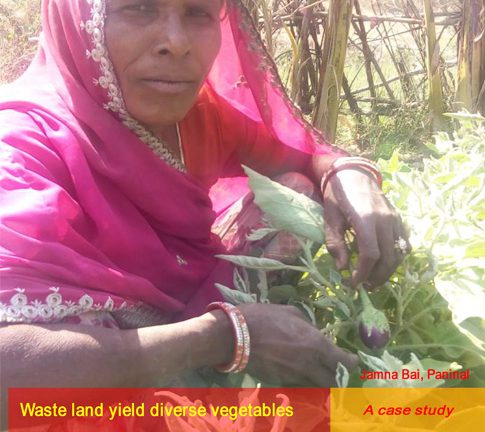
Waste land yield diverse vegetables
Jamna Bai is a forest dweller belonging to Meena tribe. Residing in Panninal village of Salumber block of Udaipur she lives in the house of family size of 9 members consisting of her daughter in-law, 2 children and other 5 male members. With the land of 1.5 bigha agriculture contributes INR 12700 which is a major source of income.
Project objective: The project titled “Improving Food Security through Sustainable Agricultural Practices and Strengthening Local Biodiversity Management”, being implemented by Prayatna Samiti with the support of Kehitysmaayhdistys Pääskyt and Ministry of Foreign Affairs, Finland, addresses vulnerable ecosystem by fostering minor millets and vegetable cultivation with the set of Good Agricultural Practices (GAP) and good governance for better management of natural resources in 10 villages.
Issues addressed: Jamna Bai became interested in vegetable cultivation as she wished to enhance the existing vegetable production which rarely yielded vegetables to her. She wished to learn the cultivation technique and procure seeds to enhance the production which she can use for family consumption.
Beneficiary interest and approach: Jamna Bai became interested in vegetable cultivation because she wished to cultivate vegetables apart from the maize and wheat. This would support her in regular vegetable intake with diverse types. Nutrition Garden was seen as an option to cultivate her existing wasteland area.
The process: Jamna Bai joined the SHG Kewda Syam Sahayata Samuha to avail the benefits of food security measures. Through the members’ consensus, she was decided to be as one of the beneficiaries. She participated in 1 training on “Minor Millets and Vegetable Cultivation” organised by Prayatna Samiti in Udaipur. Through the hands-on approach, she learned nursery raising. She got the lesson on transplantation of seedlings to promote plant growth. Prayatna Samiti provided her seeds of bottle gourd, ridge gourd, spinach, tomato, brinjal and bhindi. Along with this, she received orientation on vegetable cultivation through the IEC material. To develop the nutrition garden she identified potential in her wasteland of 40 sq. mt. The land was utilized to make a common source of 2 nutrition garden. She shared her land with her daughter-in-law, Ramu Bai, who was also the members of the same SHG. Jamna Bai after performing primary tillage left the land to be sun-dried to eradicate pests. She initiated the process with nursery raising of tomato and brinjal. To give nursery the extra cover she covered the bed with farmyard manure. The wasteland was put into use with the bed preparation during secondary tillage. Cow excreta was applied as manure to revive soil fertility. Seedlings were transplanted after 25 days in the beds prepared for vegetables. She sowed spinach and bhindi directly. Supporters were used to raise the tomatoes.
Results: She is able to produce 40 kg of vegetable with 0.25 kg harvested daily. She has saved INR 200 per week which used to spent for purchasing vegetables from Salumber. Now all the vegetables are brought from the nutrition garden. More food security is achieved as 2 women belonging to the same family shared the same piece of land for 2 gardens. Her family members are enjoying the diverse vegetables with 2 vegetables at a time in the regular meals.
Good Agricultural Practices and learning: Nursery raising is necessary to support healthy plant growth. Use of supporters increases yield and size of the fruits. Row sowing of vegetables supports healthy growth of plants, fruits and leaves and soil and water conservation. New crops cluster bean and bhindi will be sown in summers.