
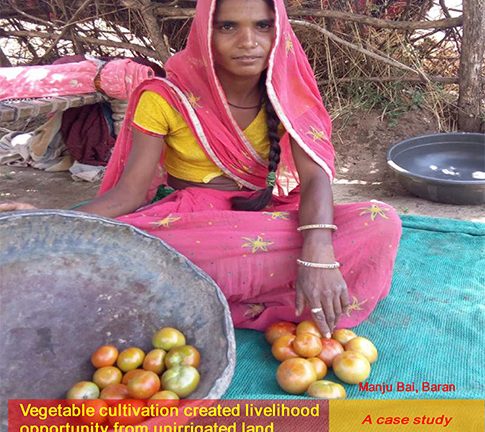
Vegetable cultivation created livelihood opportunity from unirrigated land
Manju Bai is a forest dweller belonging to Meena tribe. Residing in Baran village of Salumber block of Udaipur her
family members consists of 2 children, 2 sisters-in-law, mother-in-law and husband. Family’s sources of income depend on agriculture which contributes INR 24000 annually.
Project objective: The project titled “Improving Food Security through Sustainable Agricultural Practices and Strengthening Local Biodiversity Management”, being implemented by Prayatna Samiti with the support of Kehitysmaayhdistys Pääskyt and Ministry of Foreign Affairs, Finland, addresses vulnerable ecosystem by fostering minor millets and vegetable cultivation with the set of Good Agricultural Practices (GAP) and good governance for better management of natural resources in 10 villages.
Issues addressed: Lack of food security due to unfertile land, sloped terrain and skills for food crop cultivation. Setting up of Nutrition Garden will promote the vegetable cultivation for providing nutrition to the remotely located marginalized households. Thus, food security will satisfy the need for food crops and enhance
Beneficiary interest and approach: Manju Bai became interested in vegetable cultivation as the importance of vegetables to human beings and cultivation practices explained to her by Prayatna Samiti. Vegetable seeds were also made available. She had an interest in vegetable cultivation. Due to lack of skills and seeds, she didn’t have enough harvest for family consumption. Her husband had a dream to cultivate and sell vegetables.
The process: Manju Bai came to know the project’s objective through the SHG named Bala Ji Sayam Sahayata Samuha consisting of 15 members. In the meetings, she was oriented on vegetable cultivation through the formation of Nutrition Garden. Encouraged by the orientations she decided to procure the vegetable seeds from Prayatna Samiti. She got the seeds of bottle gourd, ridge gourd, chilli, cluster bean, tomato and Bhindi to be promoted by her. She was encouraged to irrigate a fallow piece of the land area of 215 sq. mt. positioned down the steep slopes. Within a week time period, she and her husband prepared the land. To stick with the belief of usage of cow excreta she added quality manure to the land. Nursery of chillies and tomatoes was prepared. After 30 days the seedlings were transplanted following the row fashion. Daily watering during the evening was preferred. After 30 days they noticed leaf curl and blackening in tomato leaves which raised tension and disappointment. As a solution to the infection, they were recommended to prepare and apply Five Leaf extract over the leaves which controlled the infection in
the 4 rounds of spray. The field got developed into the Nutrition Garden.
Results: After 6 months after the introduction of Nutrition Garden the field is now loaded with tomatoes and chillies yielding the daily harvest of 4 kg of tomatoes. The tomatoes are sold in the local village area at INR 20 per kilogram and consumed by the family members along with the chillies. Mother in-law of Manju Bai sells tomatoes to the nearby houses at alternate days. Till now 75 kg of tomatoes is harvested to raise the income by INR 1000.
Good Agricultural Practices and learning: Nursery raising is necessary to support healthy plant growth, spray of Five Leaf extract which is an organic manure helps in controlling bacterial, nematode and viral infections, row sowing of vegetables supports healthy growth of plants, fruits and leaves and soil and water conservation. Manju Bai has prepared another field area for cultivating bhindi, cluster bean, ridge gourd and bottle gourd. The harvest will be sold and used for family consumption.